
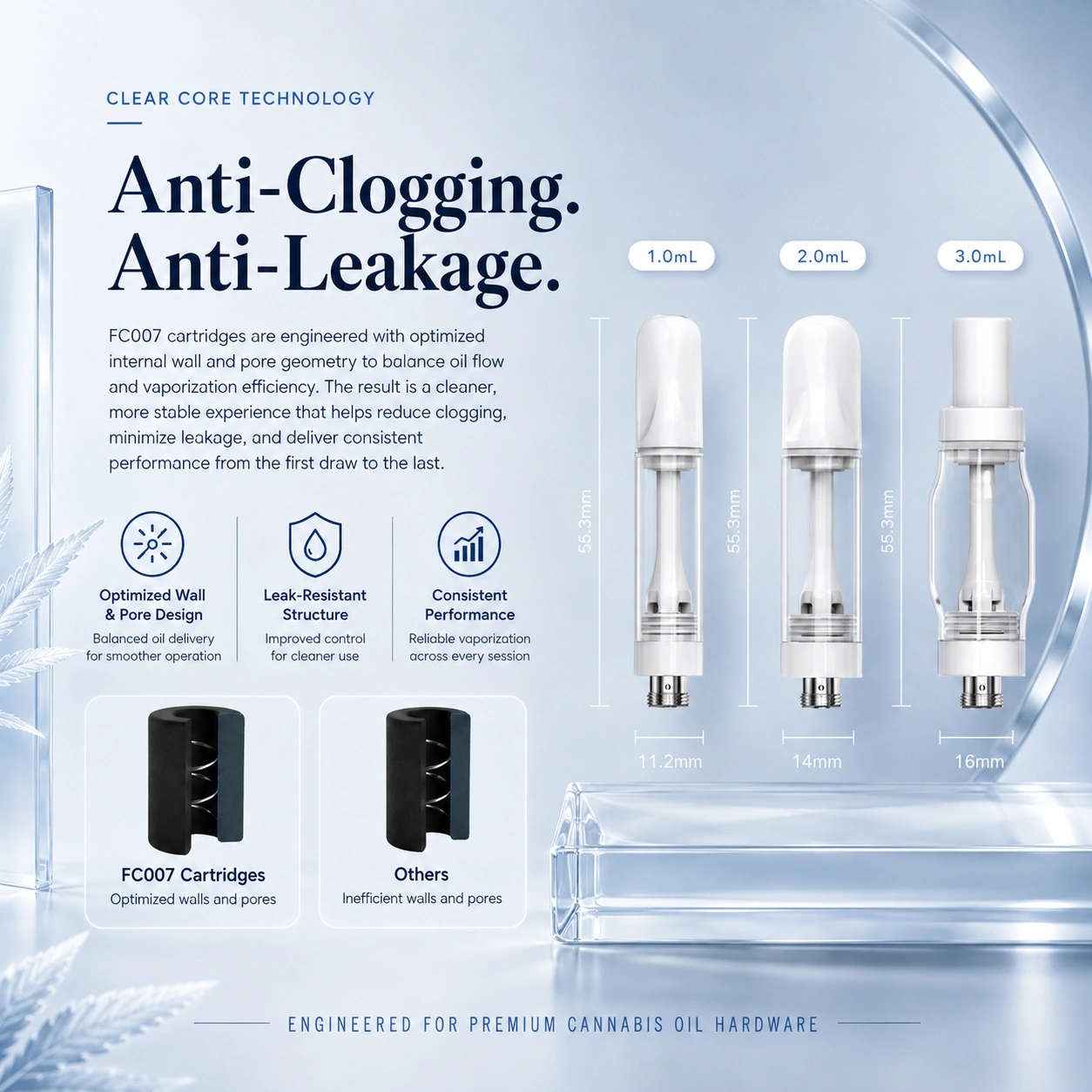
Quick Answer
Ceramic heating design helps reduce burnt flavor only when the ceramic keeps the heater supplied with oil and distributes heat in a controlled way. Burnt flavor is usually a system failure: local overheating, poor replenishment, dry spots, residue buildup, or a heater interface that concentrates heat too aggressively.
Ceramic heating design helps reduce burnt flavor only when the ceramic keeps the heater supplied with oil and distributes heat in a controlled way. Burnt flavor is usually a system failure: local overheating, poor replenishment, dry spots, residue buildup, or a heater interface that concentrates heat too aggressively.
Decision Summary
The buyer should evaluate dry-hit risk through repeated-puff testing, not single-puff taste. The key engineering variables are oil delivery rate, pore structure, heater contact, thermal conductivity, and control of the hot zone.
| Engineering question | Expert reading | Buyer action |
|---|---|---|
| What oil behavior matters first? | Burnt flavor often appears when oil supply lags behind heater demand. | Request oil-fit samples before locking a format. |
| Which ceramic parameter should be checked? | Heater adhesion and film thickness affect hot-zone stability and repeatability. | Ask for measured porosity, pore-size, and validation method. |
| What failure mode should be screened? | Dry-hit testing must include cold start, chain puff, and end-of-reservoir conditions. | Test clogging, dry-hit margin, leakage, and end-of-reservoir consistency. |
Engineering Evidence to Review
- Porous ceramic thick-film heater literature points to substrate porosity around 35% to 75%, heating film thickness around 10 to 35 micrometers, metal powder around 0.5 to 75 micrometers, and heater adhesion targets at or above 8 MPa.
- Conductive ceramic film examples include TiN, TiB2, SiC, and WC systems. One public TiN example reported about 20 micrometer film thickness, about 1.8 ohm resistance, and about 15 MPa adhesion.
- Public thick-film systems use glass bonding and partial penetration into pores to create mechanical interlocking between heater film and ceramic substrate.
- Heater adhesion examples range from an 8 MPa minimum target in metal film systems to about 15 MPa in a TiN conductive ceramic film example.
These figures are reference windows from public technical literature and the approved ceramic research notes. They are not a universal production formula. A hardware program should still validate the final structure against the actual oil, fill process, reservoir geometry, power profile, airflow path, and storage condition.
Technical Basis
A heater film that is poorly bonded or unevenly distributed can create local hot spots. A ceramic that does not replenish oil fast enough can expose the heater to partially dry material. A reservoir that traps thick oil away from the inlet can starve the core even when oil remains in the device. Ceramic helps when material, heater, and reservoir design are aligned.
What Public Technical Literature Shows
Public ceramic heater literature repeatedly focuses on film thickness, powder size, glass bonding, and adhesion because the heater interface is a failure point. A buyer should view heater film data as part of flavor consistency, not just electrical design.
Validation Steps
- 01Run dry-hit margin tests at the intended power and puff duration.
- 02Compare flavor and vapor after repeated puffs rather than after a single draw.
- 03Inspect ceramic and heater zone after testing for dark residue, dry spots, or local damage.
- 04Check whether the same result holds after storage, shipping simulation, and end-of-reservoir use.
- 05Reject claims that burnt flavor is solved without oil-specific data.
How Buyers Should Use This Evidence
The safest buyer language is reduce risk, not eliminate. A credible supplier should be able to explain where oil enters the ceramic, how heat spreads, how the heater bonds to the substrate, and how the design was tested against a thick oil.
Sample Review Criteria
Burnt flavor review should focus on risk reduction evidence. A credible sample test checks whether oil delivery, heater spread, and draw behavior remain aligned instead of relying on a generic no-burn claim.
- Run repeated draws at the target voltage or power window and record flavor drift.
- Inspect ceramic wetting and residue pattern after pauses, chain draws, and partial depletion.
- Compare dry-hit risk across oil batches or viscosity ranges when available.
- Ask the supplier to explain which design feature reduces risk and how that claim was tested.
FAQ
Can ceramic hardware still produce dry hits?
Yes. Ceramic can reduce risk when correctly matched, but dry hits can still occur if oil viscosity, pore structure, power, airflow, or reservoir geometry are mismatched.
Why does heater film adhesion matter for flavor?
Poor adhesion or uneven film structure can create unstable heating and local hot spots. Stable heater contact supports more predictable vaporization.
What test is most useful for dry-hit risk?
A repeated-puff test using the buyer's own oil, target power, fill process, and storage condition gives more useful evidence than a short demo.