
Quick Answer
An expert buyer guide to ceramic porosity, pore size, thermal conductivity, heater film adhesion, and validation logic for thick cannabis oil hardware.
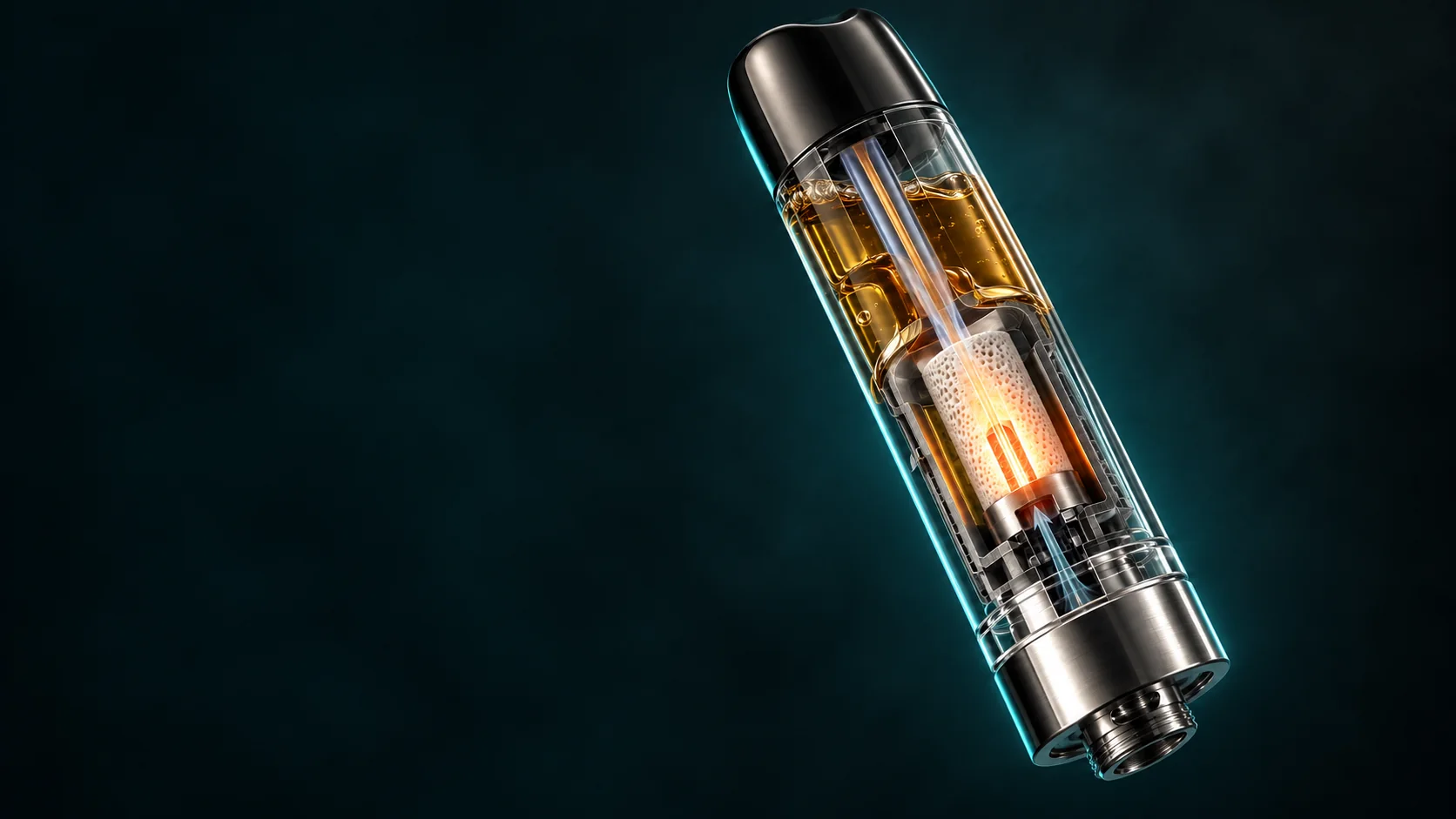
High-viscosity cannabis oil hardware should be evaluated as a coupled system: ceramic pore network, thermal pathway, heater interface, reservoir geometry, and airflow. The most useful buyer question is not whether a device uses ceramic, but whether the ceramic architecture can keep the oil supplied to the heater faster than the puff profile consumes it.
Decision Summary
For thick oil programs, public ceramic literature points to useful ranges: porosity commonly around 40% to 70%, pore size often in the 12 to 30 micrometer range for SiC-style high-viscosity work, and thermal conductivity targets beginning around 0.3 W/mK. Those numbers are reference windows, not guarantees. The final decision must be made through oil-specific sample validation.
| Engineering question | Expert reading | Buyer action |
|---|---|---|
| What oil behavior matters first? | Viscosity changes with temperature, so cold-start and end-of-reservoir behavior matter. | Request oil-fit samples before locking a format. |
| Which ceramic parameter should be checked? | Porosity, pore-size distribution, thermal conductivity, heater adhesion, and strength should be reviewed together. | Ask for measured porosity, pore-size, and validation method. |
| What failure mode should be screened? | A ceramic that wicks in a short demo can still fail under repeated puffs, storage, or high-fill-volume use. | Test clogging, dry-hit margin, leakage, and end-of-reservoir consistency. |
Engineering Evidence to Review
- SiC-containing ceramic literature for thicker oils emphasizes thermal conductivity at or above 0.3 W/mK, a broader 0.3 to 5 W/mK discussion window, 40% to 70% porosity, and 12 to 30 micrometer pore size.
- Public high-viscosity oil discussion often references CBD/THC-type oils above 2000 cP at 25 C and below 600 cP when warmed into the 60 to 120 C range.
- Suggested high-conductivity design windows from the research notes include 50% to 55% porosity, 15 to 25 micrometer average pore size, 1 to 2.5 W/mK thermal conductivity, and 15 to 20 MPa flexural strength.
- Lucas-Washburn capillary logic shows that viscosity, wetting angle, pore radius, permeability, and tortuosity interact. Larger pores alone do not create a stable oil delivery system.
These figures are reference windows from public technical literature and the approved ceramic research notes. They are not a universal production formula. A hardware program should still validate the final structure against the actual oil, fill process, reservoir geometry, power profile, airflow path, and storage condition.
Technical Basis
A thick oil cartridge or AIO device fails when heat generation, capillary replenishment, and airflow demand fall out of balance. Ceramic materials can support this balance because they can combine capillary pores, heat spreading, and dimensional stability. But the ceramic must be tuned for the actual oil. A high-viscosity live rosin oil may need different pore and thermal behavior from a lower-viscosity distillate, even when the outside hardware looks similar.
What Public Technical Literature Shows
The important signal from public ceramic atomization literature is the shift from single-material claims to system engineering. Porosity without strength can crack. Heat without capillary flow can create dry hits. Small pores without permeability can starve the heater. Large pores without a liquid-locking function can leak or flood. Expert evaluation connects these variables before pilot production.
Validation Steps
- 01Record oil type, target viscosity range, fill volume, and expected puff profile before requesting samples.
- 02Ask the supplier which ceramic parameters are controlledporosity, pore-size distribution, permeability, strength, thermal conductivity, and heater adhesion.
- 03Run cold-start, chain-puff, rest-after-fill, storage, and end-of-reservoir checks on the same oil.
- 04Compare vapor output, taste stability, leakage, clogging, and residue buildup across at least two hardware options.
- 05Only move to pilot order after the ceramic architecture is validated against the real oil and filling process.
How Buyers Should Use This Evidence
A strong supplier should be able to explain why a ceramic structure fits a target oil behavior. If the explanation stops at generic phrases such as ceramic core, smooth taste, or no burn, the buyer should request measurable data and a sample test plan.
Sample Review Criteria
Use sample review to confirm that the ceramic architecture fits the actual oil, not only the target hardware format. The review should connect viscosity behavior, ceramic saturation, heater response, and post-fill stability before a buyer treats the design as production-ready.
- Review oil viscosity behavior at room temperature and after controlled warming.
- Check whether the ceramic remains saturated during low-temperature draws and repeated draws.
- Inspect inlet behavior, vapor consistency, and residue pattern after partial reservoir depletion.
- Ask for the ceramic structure, heater interface, and sample-test conditions to be documented in the project record.
FAQ
Is higher porosity always better for thick oil?
No. Higher porosity can support oil storage and transport, but it can reduce mechanical strength or allow too much liquid movement. Thick oil hardware needs controlled pore size, pore connectivity, and thermal behavior, not just a high porosity number.
Why does thermal conductivity matter for high-viscosity oils?
When the ceramic spreads heat into the oil contact zone, viscosity can drop locally and replenishment can improve. If heat is too concentrated at the heater interface, the oil near the heater can be consumed faster than the ceramic can resupply it.
Can one ceramic core work for every cannabis oil?
A single structure may cover a broad range, but expert programs usually validate separate windows for distillate, live resin, live rosin, and CBD oil because viscosity, terpene behavior, and storage conditions differ.