
Quick Answer
A lower temperature reading can conceal losses elsewhere. How to evaluate thermal performance, aerosol recovery, draw resistance and energy before committing an ODM concept to tooling.
A lower temperature reading is only the start
Thermal management in cannabis vape hardware should be judged at the system level: where heat is generated, where it goes, and what reaches the outlet. A cooler mouthpiece or downstream surface does not, by itself, establish better aerosol delivery, preserved flavor or lower emissions. A useful design must demonstrate its thermal benefit alongside draw resistance, material recovery, repeatability and battery demand.
That distinction matters in custom hardware development. A promising temperature curve can justify another experiment. It cannot yet justify tooling.
This article sets out an engineering evaluation framework, not results from a CLEARVAPE prototype or a claim that an active-cooling device is ready for production.
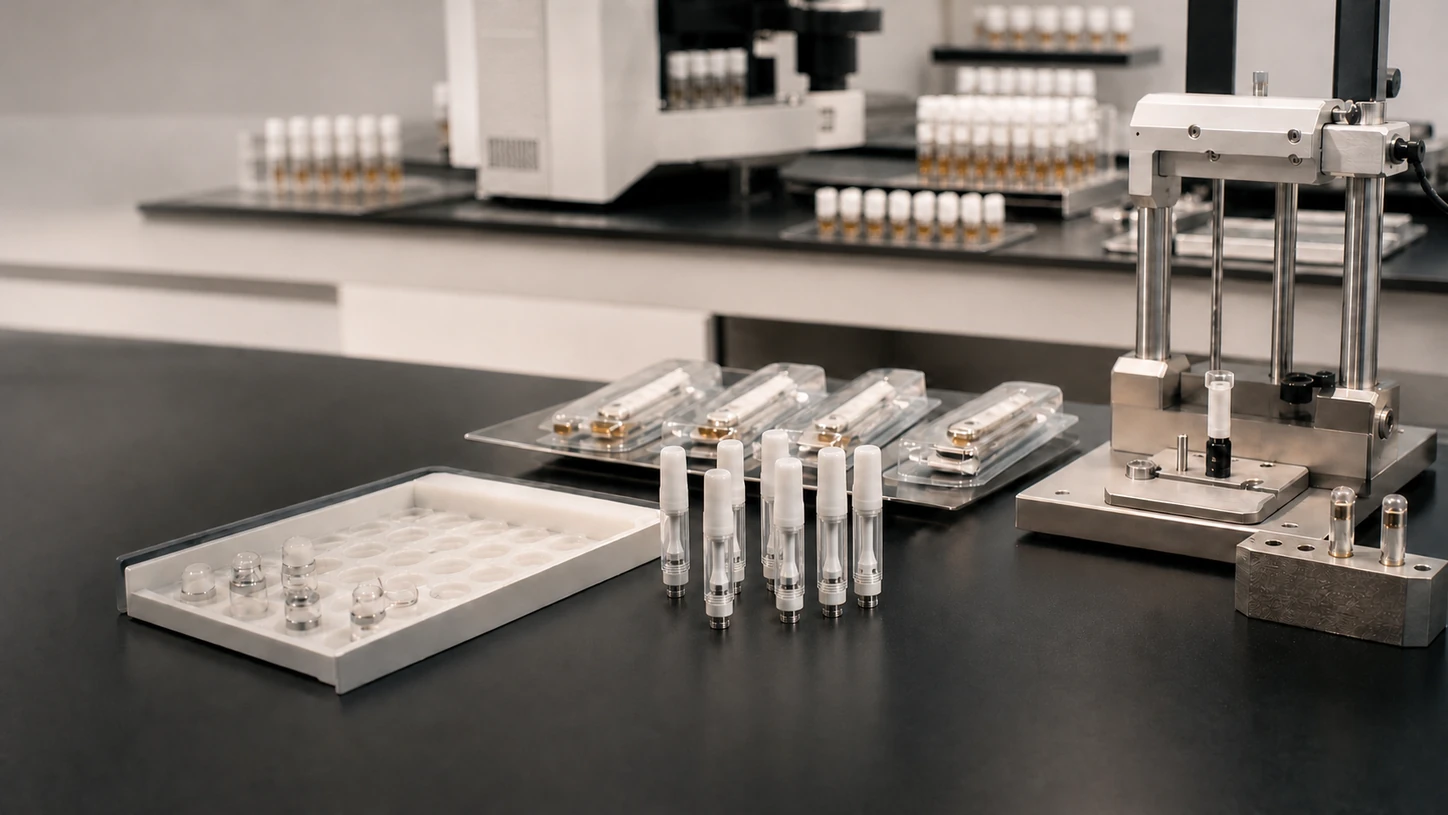
The header image is an existing website illustration, not a record of the experiments discussed here.
First define which temperature the design is meant to change
“Cooler” can describe the heater, an internal wall, the mouthpiece surface or the stream leaving the device. These are different measurements. A comfortable exterior tells little about the heater's temperature history. A cold internal wall tells little about the temperature distribution in a moving aerosol.
A published thermography study compared one temperature-controlled and two voltage-controlled cannabis vaporization systems. Voltage was a poor predictor of coil temperature in the tested devices. The cartridges were modified to expose the coils, so the results should not be treated as a universal temperature map for intact products. The study was manufacturer-affiliated; its scope and method matter more than any brand comparison. Read the study and its limitations.
For an engineering brief, replace “make the vapor cooler” with a defined measurement location, operating condition and comparison. Record the complete time history. A single minimum value can hide a hot start, sensor lag or a rising temperature over repeated draws.
Compare the trade-offs before choosing the mechanism
| Design direction | What it may address | What the experiment must also check |
|---|---|---|
| Heater control and oil supply | Temperature variation at aerosol generation | Wetting consistency, transient response and output across fill levels |
| Passive geometry or thermal mass | Heat transfer along the flow path | Draw resistance, deposition, warm-up and recovery between draws |
| Active thermal management | An additional means of controlling a selected temperature | Heat rejection, electrical load, fault behavior and retained output |
None is inherently the best approach for every extract or device format. Compare the simplest credible baseline before adding components. If a passive change achieves the agreed target with fewer failure modes, the active system needs a measurable reason to remain.
Cooling moves the engineering problem; it does not remove it
Thermoelectric cooling is one possible approach, not a default recommendation. Its hot side must reject both the heat moved from the cold side and the electrical energy supplied to the module. A cold-face specification alone therefore cannot establish performance inside a compact enclosure. This heat-rejection requirement is explained in the thermoelectric heat-sink reference guide.
A useful feasibility report would show the thermal behavior of the assembled device, including enclosure and battery temperatures, under its intended duty cycle. It would also compare energy consumption and performance as battery state of charge changes. A successful first draw from a fully cooled fixture is a narrow result; it says little about a warm device used repeatedly.
The design question is practical: where can the heat go, and how much space, energy and recovery time does that require? If the answer depends on a laboratory fixture that cannot fit the product, the fixture has demonstrated a principle, not a product architecture.
Track what leaves the device—and what stays inside
A thermal modification changes the conditions along the aerosol path. It may also change how much material collects on internal surfaces. A lower outlet reading accompanied by lower delivered mass needs investigation before it is described as an improvement.
Keep three quantities separate: material consumed from the reservoir, material recovered at the outlet, and material retained in the device. They are not interchangeable. Gravimetric output is also not a measurement of individual cannabinoids or terpenes; composition requires a suitable analytical method.
Collection itself can introduce losses. Report blanks, recovery checks, sampling losses and unexplained mass rather than forcing an apparent balance. If a collection system captures only part of the aerosol, its result should be described as recovered mass under that method—not total delivery to a person.
Record pressure drop at specified flow conditions alongside these measurements. Otherwise a design can appear cooler simply because it changes the flow or reduces output. For buyer-facing context, our hardware engineering guide connects airflow, filling and mechanical interfaces.
Live resin, live rosin and distillate are not test specifications
These names help describe a product category. They do not fully define a test fluid. The evaluation still needs a controlled description of the batch, its relevant composition, handling history and viscosity measurement conditions. A viscosity value without a stated temperature and method is difficult to compare.
Research using simplified THC and β-myrcene mixtures examined how terpene concentration and power affected active-ingredient transfer and volatile degradation products. The findings depended on the experimental conditions; the authors caution against extending them to other formulations. They do not establish a universal operating temperature for live resin or live rosin. See the study of terpene content and cannabis aerosol composition.
Use representative formulations to test a defined application, not to manufacture a blanket “compatible with all oils” claim. Bench surrogates can help isolate thermal or mechanical variables, but matching one physical property does not establish chemical or aerosol equivalence. Our oil and extract science guide provides the broader formulation context.
Build an evidence package that can survive design review
The following is a proposed evaluation sequence. It contains no measured performance claims and no universal pass limits. Acceptance criteria should be agreed before testing, with the responsible engineering team and qualified laboratories.
1. Establish a fair baseline
Document the hardware revision, oil batch, fill condition, ambient conditions, flow profile, power settings and rest intervals. Define what stays constant between variants. Where a change necessarily alters another variable, report it explicitly. Use multiple units and repeated runs; choose sample size around the variability and decision being studied.
2. Validate the measurements
Specify sensor position, calibration, response time and uncertainty. Check whether the probe disturbs the flow or measures a surface rather than the intended stream. Synchronize temperature, pressure, flow and electrical records so a transient in one signal can be compared with the others.
3. Evaluate repeated use
Compare clean and conditioned hardware, relevant orientations and different fill levels. Inspect retained material, seal condition and changes in draw resistance. Investigate whether performance recovers after rest or cleaning where cleaning is part of the intended product use. An unexplained drift is a design-review finding, not an inconvenient data point.
4. Separate physical performance from chemical claims
Neither a temperature reduction nor a pleasant sensory impression proves reduced harmful emissions. Any chemical claim needs an appropriate sampling method, analytical scope and comparison. Report detection limits and uncertainty. Do not infer “safer,” “terpene-preserving” or “cleaner” from a thermal graph alone.
5. Decide before committing to tooling
Agree in advance what evidence supports another prototype, what requires redesign and what ends the approach. An outlet-temperature benefit that disappears with repeated use, excessive deposition or an impractical energy budget can be a valid reason to stop. The value of feasibility work is the decision it enables, including a negative one.
What an ODM buyer should ask for
- A clear distinction between a calculation, a simulation, a bench result and a production-qualified result.
- A traceable test method, raw time-series data and a record of failed runs—not only selected plots.
- The comparison baseline, unit count, repeatability and uncertainty behind each claimed improvement.
- A combined review of thermal performance, recovered output, pressure drop, energy and material condition.
- Named responsibility for engineering work and external laboratory work, without implying either has already been completed.
- A staged development scope with decision points before tooling and production commitments.
These questions belong in the custom cannabis hardware development brief. They should also connect to the project's quality and validation requirements, rather than remain a separate research presentation.
Questions worth resolving early
Does a cooler mouthpiece mean the aerosol is safer?
No. Mouthpiece temperature is a surface measurement. It does not establish aerosol composition or exposure. Those questions require separate sampling and chemical analysis; a thermal improvement alone cannot support a safety claim.
Can one thermal design work with live rosin, live resin and distillate?
Possibly, within a defined operating range, but the category names are insufficient evidence. Compatibility must be evaluated against representative formulations, fill conditions and use patterns. A result for one batch should not be presented as validation for every extract in that category.
Should active cooling be included in an ODM specification from the outset?
Specify the problem and measurable acceptance criteria first. Treat active cooling as a candidate approach to compare with simpler alternatives. Its inclusion should depend on system-level evidence, not the appeal of the mechanism.
Start with the question the prototype must answer
A serious cannabis vape hardware project does not need certainty at the concept stage. It needs a testable question and an honest way to decide whether the answer is good enough.
For an initial discussion, share the device format, extract category and behavior you need to evaluate. Feasibility, sample availability and any specialist testing scope must be assessed individually; an inquiry is not confirmation that a concept can be manufactured.